
Iconomy Group CEO Attends SUSS Law Fireside Chat with Chief Justice Sundaresh Menon
· iconomy
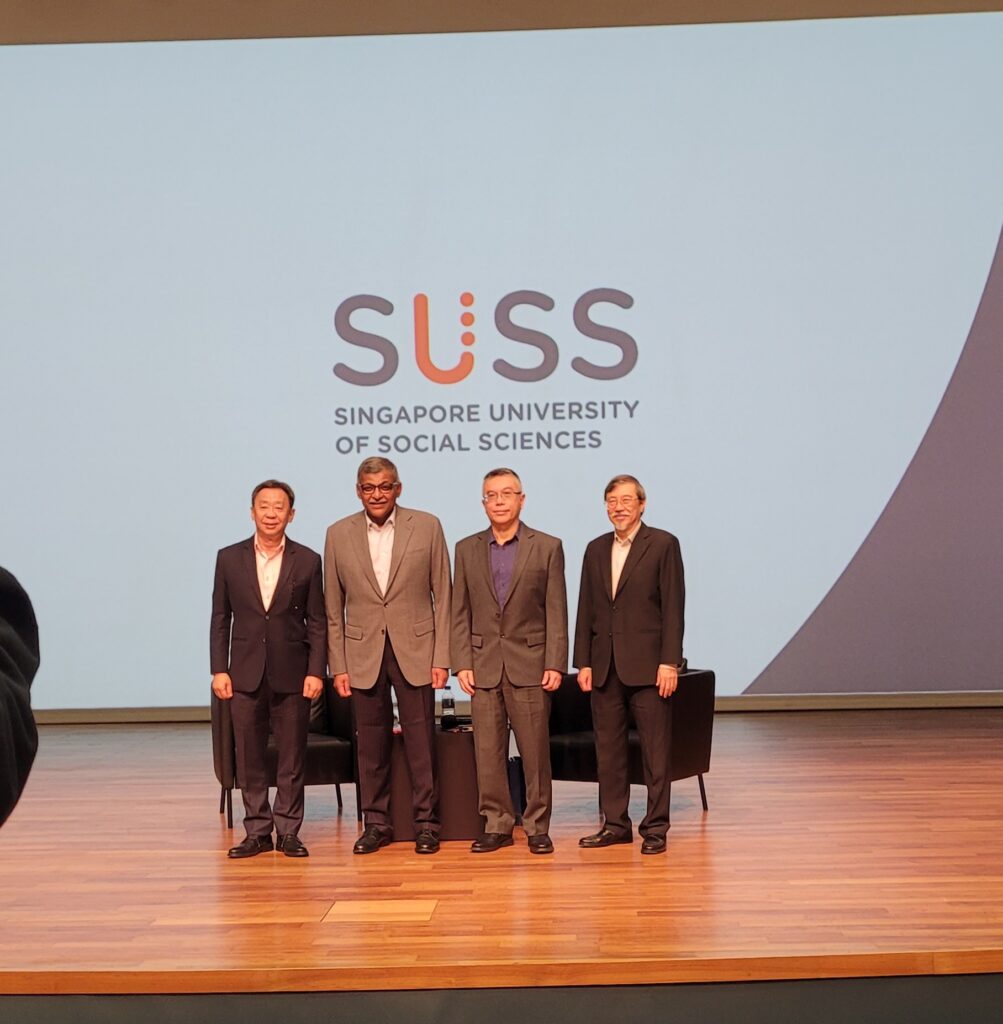
Singapore, 18 August 2023 – Iconomy Group Chief Executive Officer Mr Boo Kok Chuon attended a fireside chat organised by the Singapore University of Social Sciences School of Law featuring Chief Justice Sundaresh Menon, as part of his continuing engagement with Singapore’s legal and institutional community.
The session provided an opportunity for students and members of the legal community to hear directly from the Chief Justice on the changing role of courts, lawyers and dispute-resolution institutions in Singapore.
Among the themes discussed was therapeutic justice, particularly the proposition that legal processes should not invariably be understood as contests in which one party wins and another loses.
In family justice, this is especially significant. The breakdown of a family frequently leaves parties connected through children, financial responsibilities and continuing relationships long after formal proceedings have concluded. A purely adversarial process may therefore resolve the immediate legal dispute without necessarily addressing the deeper conflict or helping parties establish a workable relationship for the future.
Singapore’s family justice system has progressively embraced therapeutic justice as an overarching philosophy, placing greater emphasis on problem-solving, multidisciplinary intervention and solutions that consider the future interests of the family rather than focusing exclusively on past fault. The Family Justice Courts subsequently gave this approach more concrete institutional expression through the Therapeutic Justice Model.
The discussion also touched upon the wider role of alternative dispute resolution, including mediation, and the importance of choosing a dispute-resolution process that is appropriate to the nature of the dispute and the needs of the parties.
Seen retrospectively, this aspect of the discussion forms part of a broader evolution in how dispute resolution is increasingly conceptualised in Singapore.
Rather than viewing mediation and other non-court processes merely as “alternatives” to litigation, members of the Singapore judiciary have increasingly emphasised the idea of Appropriate Dispute Resolution: selecting the process, or combination of processes, best suited to the particular dispute.
Chief Justice Menon had already articulated this approach in 2016, suggesting that the familiar abbreviation “ADR” could more usefully be understood as Appropriate Dispute Resolution, with the objective being to provide a diversified range of pathways rather than treating court adjudication as the automatic default.
That philosophy has continued to develop. Judicial speeches have since emphasised that litigation, arbitration, mediation, neutral evaluation and other processes need not be viewed as competing systems, but as different tools within a broader justice framework, each suited to different disputes and circumstances.
For Mr Boo, who was pursuing his Juris Doctor studies at SUSS, the session offered an early opportunity to consider dispute resolution not merely through the traditional lens of legal rights and adjudication, but as an institutional design question: what form of process is most capable of producing a fair, durable and proportionate outcome for the people involved?
This distinction has particular relevance beyond family law.
Commercial disputes may require authoritative adjudication where questions of precedent, enforcement or legal rights need to be determined. Other disputes may be better served by mediation, neutral evaluation or a hybrid process capable of preserving business relationships, reducing cost and focusing parties on practical outcomes.
The deeper point is that access to justice does not necessarily require every disagreement to travel along the same procedural road.
For Iconomy Group, engagement with forums such as the SUSS Law fireside chat reflects a broader interest in the intersection of law, governance and institutional design, and in how legal systems can evolve to meet the changing needs of individuals, businesses and society.
The discussion in August 2023 offered an early glimpse of a direction that has since become increasingly prominent in Singapore’s justice landscape: moving beyond the question of whether a dispute should be litigated or settled, and towards the more fundamental question of what form of dispute resolution is appropriate for the dispute itself.
Further reading:
Singapore Courts: Therapeutic Justice
Chief Justice Sundaresh Menon: Global Pound Conference Series 2016
Singapore Courts: Appropriate Dispute Resolution
Leave a Reply