
Iconomy Group CEO Raises Future-of-Work Question at Lianhe Zaobao Budget 2026 Dialogue
· iconomy
12 March 2026
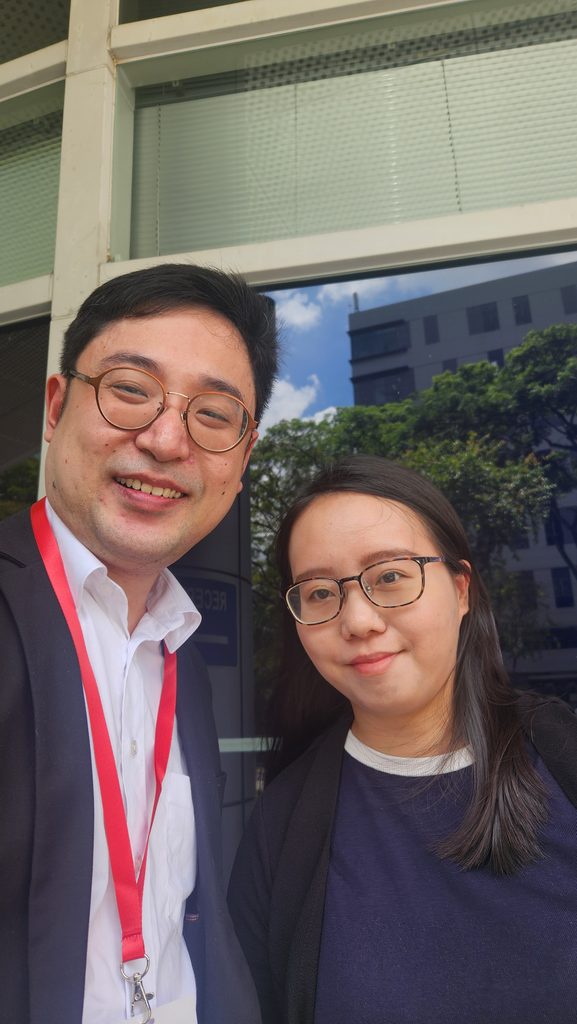
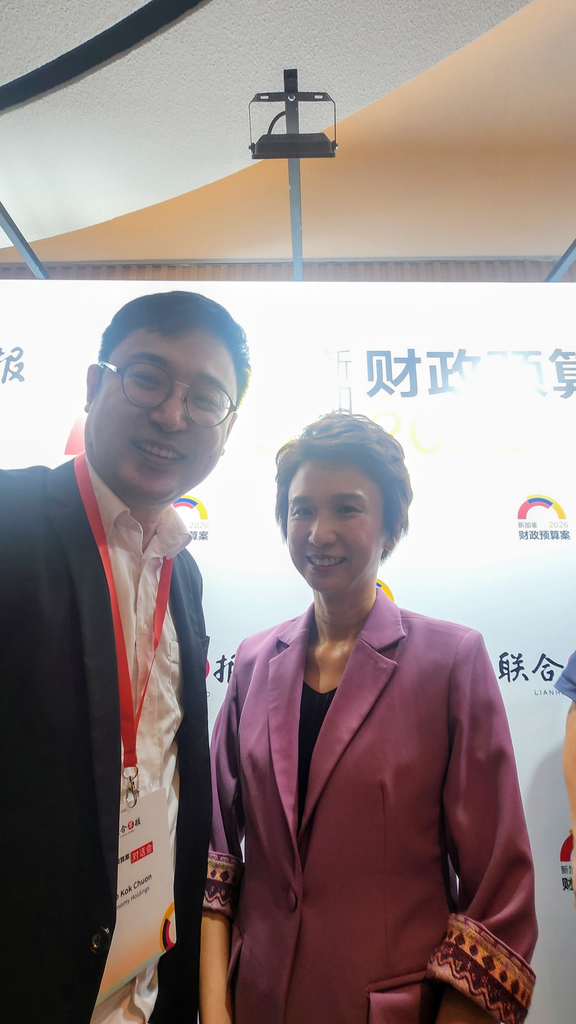
Iconomy Group Chief Executive Officer Mr Boo Kok Chuon and our Managing Director Ms Clarie Chan was invited to the Lianhe Zaobao Budget 2026 Dialogue on 12 March 2026, by the kind invitation of the moderator, Editor Shen Yue. They joined more than 170 representatives from Singapore’s business community in a discussion on artificial intelligence, workforce transformation and the challenges facing enterprises in a rapidly changing economy.
The 2026 dialogue marked the 11th year in which Lianhe Zaobao had convened its annual Budget Dialogue. Discussions brought together government and business perspectives on the implications of Budget 2026, with particular attention given to the growing adoption of artificial intelligence and its consequences for businesses and workers.
Mr Boo attended the dialogue representing Iconomy Group, whose business heritage began in printing, publishing and marketing before developing into a broader multidisciplinary group. Reflecting those roots, Lianhe Zaobao identified Mr Boo in its Chinese-language coverage as an executive of Iconomy Group engaged in printing and marketing.
When AI Transforms Work, What Happens to the Worker?
A major theme of the dialogue concerned the impact of artificial intelligence on employment.
Senior Minister of State Dr Koh Poh Koon observed that while AI could substantially increase productivity, human judgement remained important, particularly when businesses encountered unusual circumstances for which automated systems might not be adequately prepared.
The discussion therefore extended beyond the adoption of AI tools to the development of workers themselves. Businesses would need employees capable not merely of operating AI systems, but of exercising judgement when those systems encountered their limitations. Dr Koh also discussed the changing role of human-resource functions, with greater emphasis potentially being placed on workforce development and training as AI assumes some conventional administrative and recruitment functions.
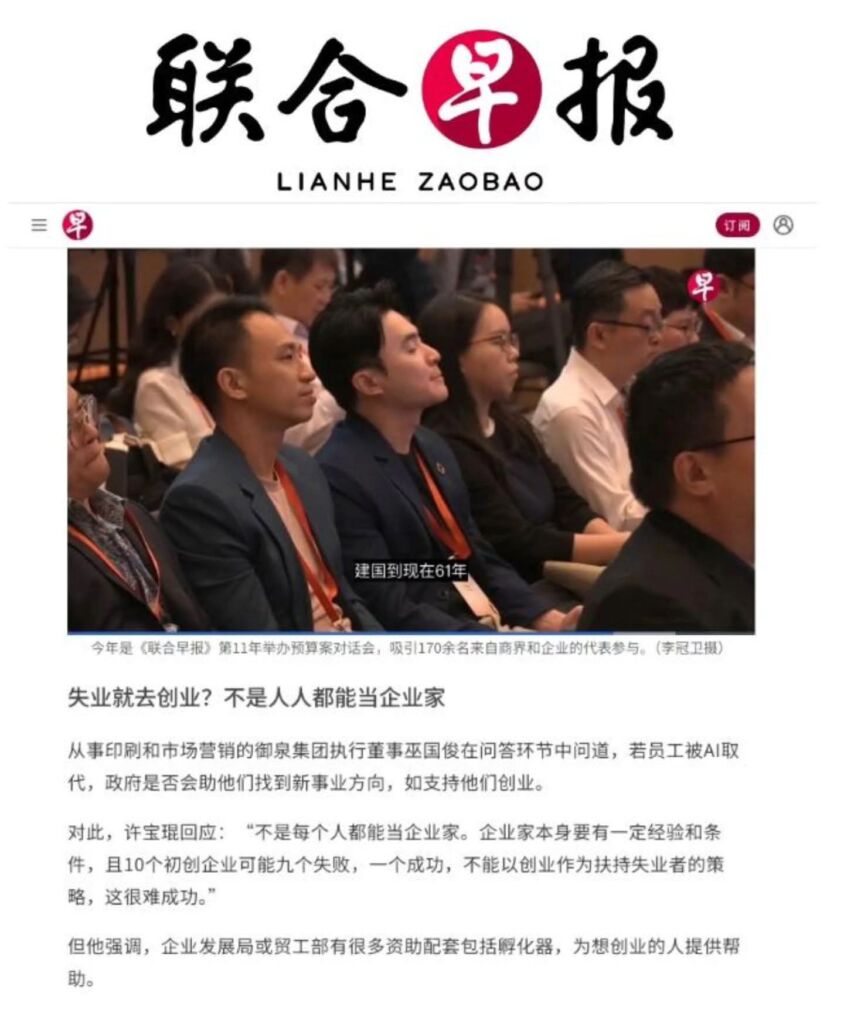
It was against this wider discussion that Mr Boo raised a question during the dialogue’s question-and-answer session.
He asked what might happen to workers whose existing roles were ultimately displaced by AI, and whether Government support could help such individuals identify alternative economic pathways, including entrepreneurship.
The question and Dr Koh’s response were subsequently reported by Lianhe Zaobao.
Entrepreneurship Is Not for Everyone
Dr Koh cautioned against treating entrepreneurship as a general solution to unemployment.
He observed that not everyone possesses the experience and circumstances required to become an entrepreneur, while the failure rate among new businesses remains substantial. Entrepreneurship therefore could not simply become a default support strategy for workers displaced from employment.
At the same time, he noted that support was available through agencies including Enterprise Singapore and the Ministry of Trade and Industry for individuals who wished to pursue entrepreneurship, including various assistance programmes and incubators.
Mr Boo subsequently clarified that he agreed with the fundamental proposition that not everyone should become an entrepreneur.
The distinction underlying his question was instead between entrepreneurship as an occupation and entrepreneurial capability as a form of human capital.
Beyond Entrepreneurship: Developing Entrepreneurial Capability
Becoming an entrepreneur is an occupational choice involving risk, responsibility and circumstances that will not suit everyone.
Entrepreneurial capabilities, however, have considerably wider application.
The ability to identify opportunities, organise resources, evaluate and assume manageable risks, exercise initiative and create economic value can be useful whether an individual ultimately becomes an entrepreneur, employee, independent professional or participant in the gig economy.
This distinction becomes increasingly significant as technology changes the organisation of work.
Traditional assumptions that education would lead to stable employment followed by a largely predictable career may become less reliable where AI can automate individual functions, reorganise occupations and allow productive activities to be undertaken through increasingly decentralised business structures.
The policy question is therefore broader than whether workers displaced by AI should be encouraged to establish companies.
It is also whether workers can be equipped with sufficient economic adaptability, initiative and value-creation capabilities to navigate a labour market in which the boundaries between employment, self-employment, enterprise and independent professional work may become increasingly fluid.
From Research to Public Dialogue
The question raised at the Budget Dialogue was connected to a broader body of economic thinking previously explored through the Iconomy Bookcase.
In his earlier commentary on enterprise theory, workforce structure and technological change, Mr Boo examined how productive capacity need not necessarily increase proportionately with organisational headcount as technology enables businesses to achieve greater output through leaner structures.
The analysis considered entrepreneurship and alternative forms of economic participation not simply as substitutes for conventional employment, but as part of a broader discussion about how individuals and businesses may adapt to structural changes in the economy.
The exchange at the Lianhe Zaobao Budget Dialogue brought that discussion from written commentary into a public policy forum, where the proposition could be considered alongside the practical concerns of policymakers, employers and fellow business leaders.
Related Commentary:
Beyond Headcount: Leveraging Enterprise Theory to Solve the 0.97 TFR Crisis | Iconomy Bookcase
Participating in the Conversation on Singapore’s Economic Future
Iconomy’s participation in the dialogue formed part of the Group’s continuing engagement with discussions concerning enterprise development, technological transformation and Singapore’s economic future.
For a Group whose origins lie in printing, publishing and marketing, technological disruption is not an abstract subject. Successive waves of digitalisation have transformed the production, distribution and consumption of information, reshaping industries that once depended heavily upon physical production and traditional organisational structures.
Artificial intelligence represents another stage in that continuing transformation.
The question facing businesses is consequently not merely how many functions technology can automate, but how enterprises and individuals can continue developing the capabilities necessary to create value as technology changes the manner in which economic activity is organised.
Iconomy was honoured to participate in the 2026 Lianhe Zaobao Budget Dialogue and to contribute to the wider conversation on artificial intelligence, entrepreneurship, workforce adaptability and the future of work.
Contemporary Coverage:
Lianhe Zaobao: AI让企业如叶问“一打十” 但仍须靠人不能“零打十”
Leave a Reply